






\(10\times\) Faster Sumcheck

over Binary Tower Fields

Suyash Bagad

Ingonyama

Yuval Domb

Ingonyama

Justin Thaler

a16z & Georgetown University

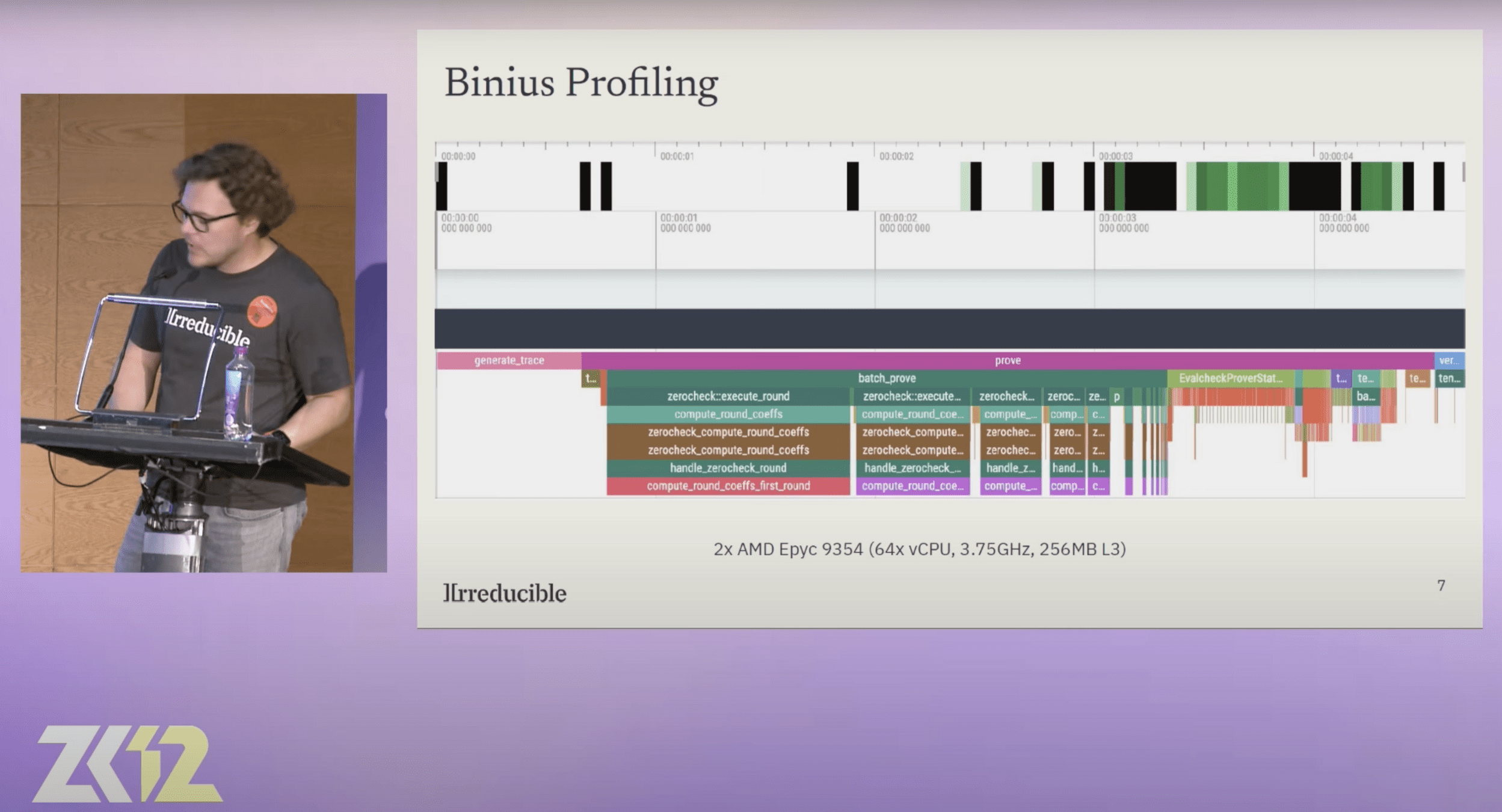
Sumcheck: The new bottleneck

  • Binius enables efficient SNARKs over binary fields
  • Fast commitment scheme + sumcheck based IOPs
  • Commitment part is so fast that sumcheck becomes the bottleneck

Credit: Radi Cojbasic's talk at zk summit 12.

  • Binius enables efficient SNARKs over binary fields
  • Fast commitment scheme + sumcheck based IOPs
  • Commitment part is so fast that sumcheck becomes the bottleneck
  • Aim: speed-up first few rounds of sumcheck

Credit: Radi Cojbasic's talk at zk summit 12.

Sumcheck: The new bottleneck

Sumcheck over Binary Fields

  • Binary fields are fields of characteristic \(2\) of the form \(\textsf{GF}(2^n)\)
  • When \(n = 1\), we get: \(\textsf{GF}(2)\) \(= \{0, 1\} \equiv \mathbb{F}_2\)
    • Addition is bitwise XOR and multiplication is bitwise AND
  • When \(n = 2\), the field \(\textsf{GF}(2^2)\) is a degree-2 extension of \(\textsf{GF}(2)\)
    • Let \(m(x) = x^2 + x + 1\) be the irreducible polynomial
    • Any polynomial \(p(x)\) over \(\mathbb{F}_2\) when divided by \(m(x)\) gives the remainder
  • In binius sumcheck:
    • The witness is from the base field \(\textsf{GF}(2)\) while
    • But the challenge is from the extension field \(\textsf{GF}(2^{128})\)
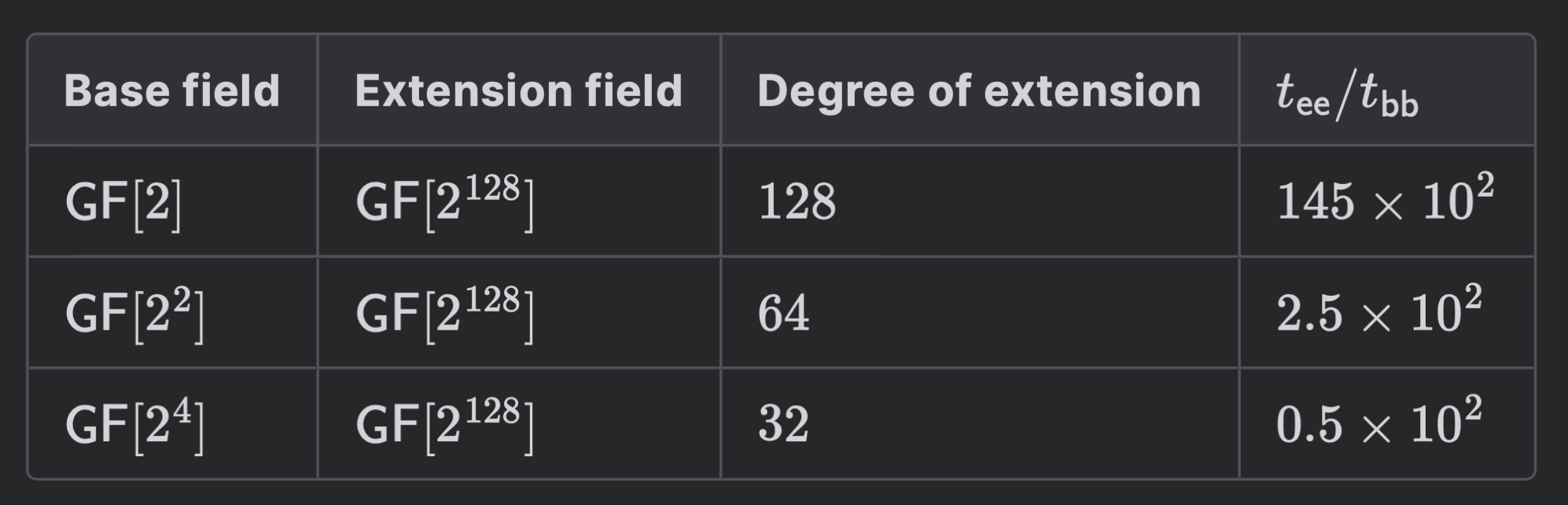
  • Running sumcheck naively results in lots of extension field multiplications
1x + 0
0x + 0
0x + 1
1x + 1

Multiplication in Binary Tower Fields

\textsf{GF}(2) \ \xrightarrow[\text{extension}]{\text{deg-2}} \ \textsf{GF}(2^2) \ \xrightarrow[\text{extension}]{\text{deg-2}} \ \textsf{GF}(2^4) \ \xrightarrow[\text{extension}]{\text{deg-2}} \ \textsf{GF}(2^8)
\textcolor{grey}{0}
\textcolor{lightgreen}{1}
\textcolor{grey}{0}xy + \textcolor{grey}{0}y +\textcolor{grey}{0}x + \textcolor{grey}{0}
\textcolor{grey}{0}xy + \textcolor{grey}{0}y +\textcolor{grey}{0}x + \textcolor{lightgreen}{1}
\textcolor{grey}{0}xy + \textcolor{grey}{0}y +\textcolor{lightgreen}{1}x + \textcolor{grey}{0}
\textcolor{grey}{0}xy + \textcolor{grey}{0}y + \textcolor{lightgreen}{1}x + \textcolor{lightgreen}{1}
\textcolor{grey}{0}xy + \textcolor{lightgreen}{1}y + \textcolor{grey}{0}x + \textcolor{grey}{0}
\textcolor{grey}{0}xy + \textcolor{lightgreen}{1}y +\textcolor{grey}{0}x + \textcolor{lightgreen}{1}
\textcolor{grey}{0}xy + \textcolor{lightgreen}{1}y +\textcolor{lightgreen}{1}x + \textcolor{grey}{0}
\textcolor{grey}{0}xy + \textcolor{lightgreen}{1}y + \textcolor{lightgreen}{1}x + \textcolor{lightgreen}{1}
\textcolor{lightgreen}{1}xy + \textcolor{grey}{0}y + \textcolor{grey}{0}x + \textcolor{grey}{0}
\textcolor{lightgreen}{1}xy + \textcolor{grey}{0}y +\textcolor{grey}{0}x + \textcolor{lightgreen}{1}
\textcolor{lightgreen}{1}xy + \textcolor{grey}{0}y +\textcolor{lightgreen}{1}x + \textcolor{grey}{0}
\textcolor{lightgreen}{1}xy + \textcolor{grey}{0}y + \textcolor{lightgreen}{1}x + \textcolor{lightgreen}{1}
\textcolor{lightgreen}{1}xy + \textcolor{lightgreen}{1}y + \textcolor{grey}{0}x + \textcolor{grey}{0}
\textcolor{lightgreen}{1}xy + \textcolor{lightgreen}{1}y +\textcolor{grey}{0}x + \textcolor{lightgreen}{1}
\textcolor{lightgreen}{1}xy + \textcolor{lightgreen}{1}y +\textcolor{lightgreen}{1}x + \textcolor{grey}{0}
\textcolor{lightgreen}{1}xy + \textcolor{lightgreen}{1}y + \textcolor{lightgreen}{1}x + \textcolor{lightgreen}{1}
\textcolor{lightgreen}{1} \ \textcolor{grey}{0} \ \textcolor{grey}{0} \ \textcolor{grey}{0} \ \textcolor{lightgreen}{1} \ \textcolor{lightgreen}{1} \ \textcolor{grey}{0} \ \textcolor{lightgreen}{1}
\vdots
\vdots
\textcolor{lightgreen}{1}x + \textcolor{grey}{0}
\textcolor{grey}{0}x + \textcolor{grey}{0}
\textcolor{grey}{0}x + \textcolor{lightgreen}{1}
\textcolor{lightgreen}{1}x + \textcolor{lightgreen}{1}
\textcolor{lightgreen}{1}x + \textcolor{grey}{0}
\textcolor{grey}{0}x + \textcolor{grey}{0}
\textcolor{grey}{0}x + \textcolor{lightgreen}{1}
\textcolor{lightgreen}{1}x + \textcolor{lightgreen}{1}
\textcolor{grey}{0}
\textcolor{lightgreen}{1}
\textcolor{grey}{0}xy + \textcolor{grey}{0}y +\textcolor{grey}{0}x + \textcolor{grey}{0}
\textcolor{grey}{0}xy + \textcolor{grey}{0}y +\textcolor{grey}{0}x + \textcolor{lightgreen}{1}
\textcolor{grey}{0}xy + \textcolor{grey}{0}y +\textcolor{lightgreen}{1}x + \textcolor{grey}{0}
\textcolor{grey}{0}xy + \textcolor{grey}{0}y + \textcolor{lightgreen}{1}x + \textcolor{lightgreen}{1}
\textcolor{grey}{0}xy + \textcolor{lightgreen}{1}y + \textcolor{grey}{0}x + \textcolor{grey}{0}
\textcolor{grey}{0}xy + \textcolor{lightgreen}{1}y +\textcolor{grey}{0}x + \textcolor{lightgreen}{1}
\textcolor{grey}{0}xy + \textcolor{lightgreen}{1}y +\textcolor{lightgreen}{1}x + \textcolor{grey}{0}
\textcolor{grey}{0}xy + \textcolor{lightgreen}{1}y + \textcolor{lightgreen}{1}x + \textcolor{lightgreen}{1}
\textcolor{lightgreen}{1}xy + \textcolor{grey}{0}y + \textcolor{grey}{0}x + \textcolor{grey}{0}
\textcolor{lightgreen}{1}xy + \textcolor{grey}{0}y +\textcolor{grey}{0}x + \textcolor{lightgreen}{1}
\textcolor{lightgreen}{1}xy + \textcolor{grey}{0}y +\textcolor{lightgreen}{1}x + \textcolor{grey}{0}
\textcolor{lightgreen}{1}xy + \textcolor{grey}{0}y + \textcolor{lightgreen}{1}x + \textcolor{lightgreen}{1}
\textcolor{lightgreen}{1}xy + \textcolor{lightgreen}{1}y + \textcolor{grey}{0}x + \textcolor{grey}{0}
\textcolor{lightgreen}{1}xy + \textcolor{lightgreen}{1}y +\textcolor{grey}{0}x + \textcolor{lightgreen}{1}
\textcolor{lightgreen}{1}xy + \textcolor{lightgreen}{1}y +\textcolor{lightgreen}{1}x + \textcolor{grey}{0}
\textcolor{lightgreen}{1}xy + \textcolor{lightgreen}{1}y + \textcolor{lightgreen}{1}x + \textcolor{lightgreen}{1}
\textcolor{lightgreen}{1} \ \textcolor{grey}{0} \ \textcolor{grey}{0} \ \textcolor{grey}{0} \ \textcolor{lightgreen}{1} \ \textcolor{lightgreen}{1} \ \textcolor{grey}{0} \ \textcolor{lightgreen}{1}
\vdots
\vdots
\textsf{GF}(2) \ \xrightarrow[\text{extension}]{\text{deg-2}} \ \textsf{GF}(2^2) \ \xrightarrow[\text{extension}]{\text{deg-2}} \ \textsf{GF}(2^4) \ \xrightarrow[\text{extension}]{\text{deg-2}} \ \textsf{GF}(2^8)

Multiplication in Binary Tower Fields

\textcolor{lightgreen}{1}x + \textcolor{grey}{0}
\textcolor{grey}{0}x + \textcolor{grey}{0}
\textcolor{grey}{0}x + \textcolor{lightgreen}{1}
\textcolor{lightgreen}{1}x + \textcolor{lightgreen}{1}
\textcolor{grey}{0}
\textcolor{lightgreen}{1}
\textcolor{grey}{0}xy + \textcolor{grey}{0}y +\textcolor{grey}{0}x + \textcolor{grey}{0}
\textcolor{grey}{0}xy + \textcolor{grey}{0}y +\textcolor{grey}{0}x + \textcolor{lightgreen}{1}
\textcolor{grey}{0}xy + \textcolor{grey}{0}y +\textcolor{lightgreen}{1}x + \textcolor{grey}{0}
\textcolor{grey}{0}xy + \textcolor{grey}{0}y + \textcolor{lightgreen}{1}x + \textcolor{lightgreen}{1}
\textcolor{grey}{0}xy + \textcolor{lightgreen}{1}y + \textcolor{grey}{0}x + \textcolor{grey}{0}
\textcolor{grey}{0}xy + \textcolor{lightgreen}{1}y +\textcolor{grey}{0}x + \textcolor{lightgreen}{1}
\textcolor{grey}{0}xy + \textcolor{lightgreen}{1}y +\textcolor{lightgreen}{1}x + \textcolor{grey}{0}
\textcolor{grey}{0}xy + \textcolor{lightgreen}{1}y + \textcolor{lightgreen}{1}x + \textcolor{lightgreen}{1}
\textcolor{lightgreen}{1}xy + \textcolor{grey}{0}y + \textcolor{grey}{0}x + \textcolor{grey}{0}
\textcolor{lightgreen}{1}xy + \textcolor{grey}{0}y +\textcolor{grey}{0}x + \textcolor{lightgreen}{1}
\textcolor{lightgreen}{1}xy + \textcolor{grey}{0}y +\textcolor{lightgreen}{1}x + \textcolor{grey}{0}
\textcolor{lightgreen}{1}xy + \textcolor{grey}{0}y + \textcolor{lightgreen}{1}x + \textcolor{lightgreen}{1}
\textcolor{lightgreen}{1}xy + \textcolor{lightgreen}{1}y + \textcolor{grey}{0}x + \textcolor{grey}{0}
\textcolor{lightgreen}{1}xy + \textcolor{lightgreen}{1}y +\textcolor{grey}{0}x + \textcolor{lightgreen}{1}
\textcolor{lightgreen}{1}xy + \textcolor{lightgreen}{1}y +\textcolor{lightgreen}{1}x + \textcolor{grey}{0}
\textcolor{lightgreen}{1}xy + \textcolor{lightgreen}{1}y + \textcolor{lightgreen}{1}x + \textcolor{lightgreen}{1}
\textcolor{lightgreen}{1} \ \textcolor{grey}{0} \ \textcolor{grey}{0} \ \textcolor{grey}{0} \ \textcolor{lightgreen}{1} \ \textcolor{lightgreen}{1} \ \textcolor{grey}{0} \ \textcolor{lightgreen}{1}
\vdots
\vdots
\textsf{GF}(2) \ \xrightarrow[\text{extension}]{\text{deg-2}} \ \textsf{GF}(2^2) \ \xrightarrow[\text{extension}]{\text{deg-2}} \ \textsf{GF}(2^4) \ \xrightarrow[\text{extension}]{\text{deg-2}} \ \textsf{GF}(2^8)

Multiplication in Binary Tower Fields

\textcolor{lightgreen}{1}x + \textcolor{grey}{0}
\textcolor{grey}{0}x + \textcolor{grey}{0}
\textcolor{grey}{0}x + \textcolor{lightgreen}{1}
\textcolor{lightgreen}{1}x + \textcolor{lightgreen}{1}
\textcolor{grey}{0}
\textcolor{lightgreen}{1}
\textcolor{grey}{0}xy + \textcolor{grey}{0}y +\textcolor{grey}{0}x + \textcolor{grey}{0}
\textcolor{grey}{0}xy + \textcolor{grey}{0}y +\textcolor{grey}{0}x + \textcolor{lightgreen}{1}
\textcolor{grey}{0}xy + \textcolor{grey}{0}y +\textcolor{lightgreen}{1}x + \textcolor{grey}{0}
\textcolor{grey}{0}xy + \textcolor{grey}{0}y + \textcolor{lightgreen}{1}x + \textcolor{lightgreen}{1}
\textcolor{grey}{0}xy + \textcolor{lightgreen}{1}y + \textcolor{grey}{0}x + \textcolor{grey}{0}
\textcolor{grey}{0}xy + \textcolor{lightgreen}{1}y +\textcolor{grey}{0}x + \textcolor{lightgreen}{1}
\textcolor{grey}{0}xy + \textcolor{lightgreen}{1}y +\textcolor{lightgreen}{1}x + \textcolor{grey}{0}
\textcolor{grey}{0}xy + \textcolor{lightgreen}{1}y + \textcolor{lightgreen}{1}x + \textcolor{lightgreen}{1}
\textcolor{lightgreen}{1}xy + \textcolor{grey}{0}y + \textcolor{grey}{0}x + \textcolor{grey}{0}
\textcolor{lightgreen}{1}xy + \textcolor{grey}{0}y +\textcolor{grey}{0}x + \textcolor{lightgreen}{1}
\textcolor{lightgreen}{1}xy + \textcolor{grey}{0}y +\textcolor{lightgreen}{1}x + \textcolor{grey}{0}
\textcolor{lightgreen}{1}xy + \textcolor{grey}{0}y + \textcolor{lightgreen}{1}x + \textcolor{lightgreen}{1}
\textcolor{lightgreen}{1}xy + \textcolor{lightgreen}{1}y + \textcolor{grey}{0}x + \textcolor{grey}{0}
\textcolor{lightgreen}{1}xy + \textcolor{lightgreen}{1}y +\textcolor{grey}{0}x + \textcolor{lightgreen}{1}
\textcolor{lightgreen}{1}xy + \textcolor{lightgreen}{1}y +\textcolor{lightgreen}{1}x + \textcolor{grey}{0}
\textcolor{lightgreen}{1}xy + \textcolor{lightgreen}{1}y + \textcolor{lightgreen}{1}x + \textcolor{lightgreen}{1}
\textcolor{lightgreen}{1} \ \textcolor{grey}{0} \ \textcolor{grey}{0} \ \textcolor{grey}{0} \ \textcolor{lightgreen}{1} \ \textcolor{lightgreen}{1} \ \textcolor{grey}{0} \ \textcolor{lightgreen}{1}
\vdots
\vdots
\textsf{GF}(2) \ \xrightarrow[\text{extension}]{\text{deg-2}} \ \textsf{GF}(2^2) \ \xrightarrow[\text{extension}]{\text{deg-2}} \ \textsf{GF}(2^4) \ \xrightarrow[\text{extension}]{\text{deg-2}} \ \textsf{GF}(2^8)

Multiplication in Binary Tower Fields

\textcolor{lightgreen}{1}x + \textcolor{grey}{0}
\textcolor{grey}{0}x + \textcolor{grey}{0}
\textcolor{grey}{0}x + \textcolor{lightgreen}{1}
\textcolor{lightgreen}{1}x + \textcolor{lightgreen}{1}
\textcolor{grey}{0}
\textcolor{lightgreen}{1}
\textcolor{grey}{0}xy + \textcolor{grey}{0}y +\textcolor{grey}{0}x + \textcolor{grey}{0}
\textcolor{grey}{0}xy + \textcolor{grey}{0}y +\textcolor{grey}{0}x + \textcolor{lightgreen}{1}
\textcolor{grey}{0}xy + \textcolor{grey}{0}y +\textcolor{lightgreen}{1}x + \textcolor{grey}{0}
\textcolor{grey}{0}xy + \textcolor{grey}{0}y + \textcolor{lightgreen}{1}x + \textcolor{lightgreen}{1}
\textcolor{grey}{0}xy + \textcolor{lightgreen}{1}y + \textcolor{grey}{0}x + \textcolor{grey}{0}
\textcolor{grey}{0}xy + \textcolor{lightgreen}{1}y +\textcolor{grey}{0}x + \textcolor{lightgreen}{1}
\textcolor{grey}{0}xy + \textcolor{lightgreen}{1}y +\textcolor{lightgreen}{1}x + \textcolor{grey}{0}
\textcolor{grey}{0}xy + \textcolor{lightgreen}{1}y + \textcolor{lightgreen}{1}x + \textcolor{lightgreen}{1}
\textcolor{lightgreen}{1}xy + \textcolor{grey}{0}y + \textcolor{grey}{0}x + \textcolor{grey}{0}
\textcolor{lightgreen}{1}xy + \textcolor{grey}{0}y +\textcolor{grey}{0}x + \textcolor{lightgreen}{1}
\textcolor{lightgreen}{1}xy + \textcolor{grey}{0}y +\textcolor{lightgreen}{1}x + \textcolor{grey}{0}
\textcolor{lightgreen}{1}xy + \textcolor{grey}{0}y + \textcolor{lightgreen}{1}x + \textcolor{lightgreen}{1}
\textcolor{lightgreen}{1}xy + \textcolor{lightgreen}{1}y + \textcolor{grey}{0}x + \textcolor{grey}{0}
\textcolor{lightgreen}{1}xy + \textcolor{lightgreen}{1}y +\textcolor{grey}{0}x + \textcolor{lightgreen}{1}
\textcolor{lightgreen}{1}xy + \textcolor{lightgreen}{1}y +\textcolor{lightgreen}{1}x + \textcolor{grey}{0}
\textcolor{lightgreen}{1}xy + \textcolor{lightgreen}{1}y + \textcolor{lightgreen}{1}x + \textcolor{lightgreen}{1}
\textcolor{lightgreen}{1} \ \textcolor{grey}{0} \ \textcolor{grey}{0} \ \textcolor{grey}{0} \ \textcolor{lightgreen}{1} \ \textcolor{lightgreen}{1} \ \textcolor{grey}{0} \ \textcolor{lightgreen}{1}
\vdots
\vdots
  • Addition is bitwise XOR
  • Multiplication?
a \cdot b
=(a_{\textit{h}}x + a_{\textit{l}}) \cdot (b_{\textit{h}}x + b_{\textit{l}})
\textsf{GF}(2) \ \xrightarrow[\text{extension}]{\text{deg-2}} \ \textsf{GF}(2^2) \ \xrightarrow[\text{extension}]{\text{deg-2}} \ \textsf{GF}(2^4) \ \xrightarrow[\text{extension}]{\text{deg-2}} \ \textsf{GF}(2^8)

Multiplication in Binary Tower Fields

  • 4 smaller mult. in 1 large mult.

Our Solution

  • We devise two new algorithms for running sumcheck over "small" fields
  • Minimise \(\textsf{ee}\) multiplications (at the cost of additional \(\textsf{bb}\) multiplications)
  • Generalises for sumcheck over large fields when witnesses are small
  • Comparison with Gruen's approach of the univariate-skip technique:
    • Our approach leads to lower proof size
    • Our techniques apply to existing sum-check-based SNARKs “as is”
    • Applicability to composition polynomial may lead to memory overheads 

Implementation

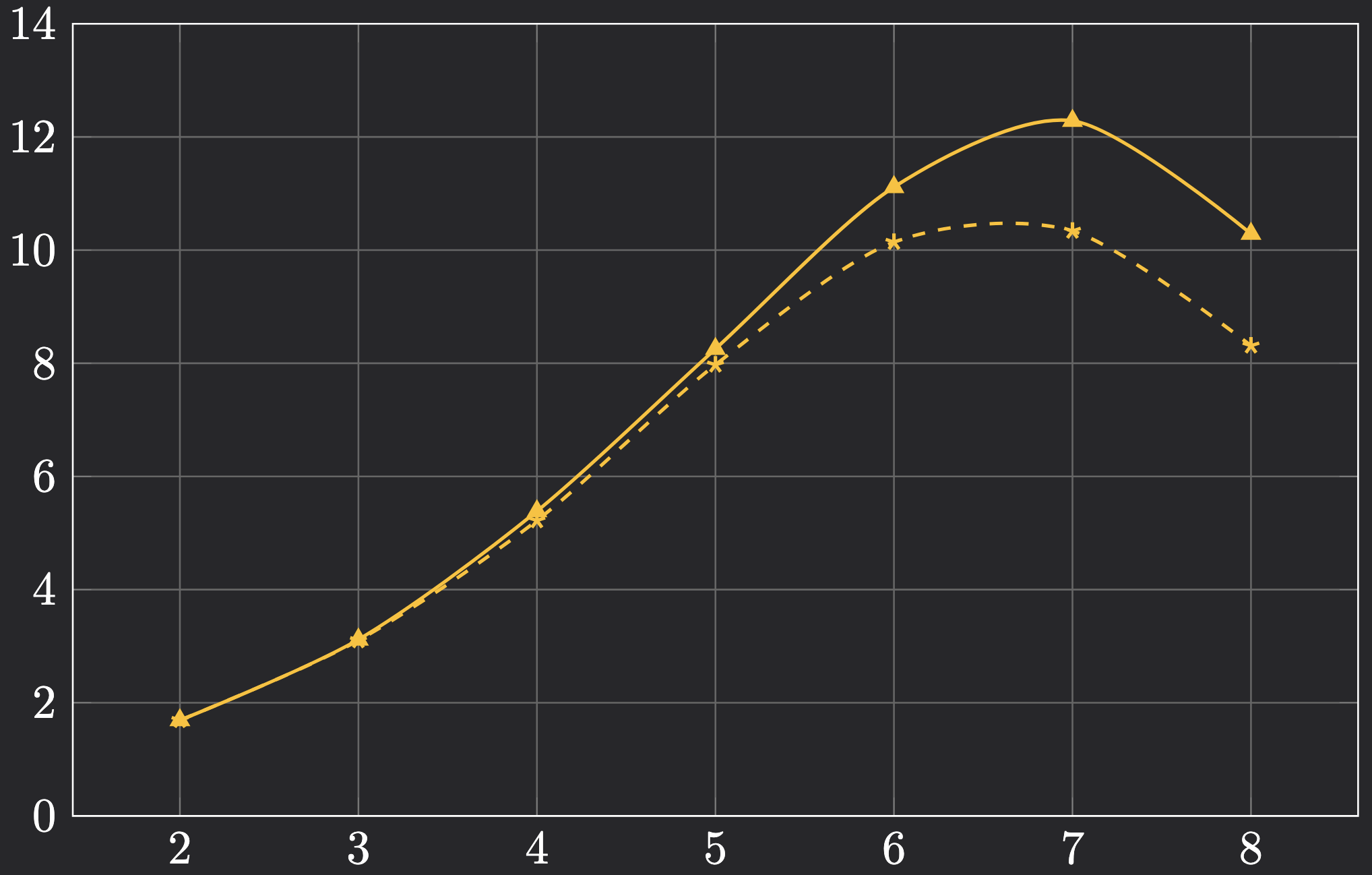
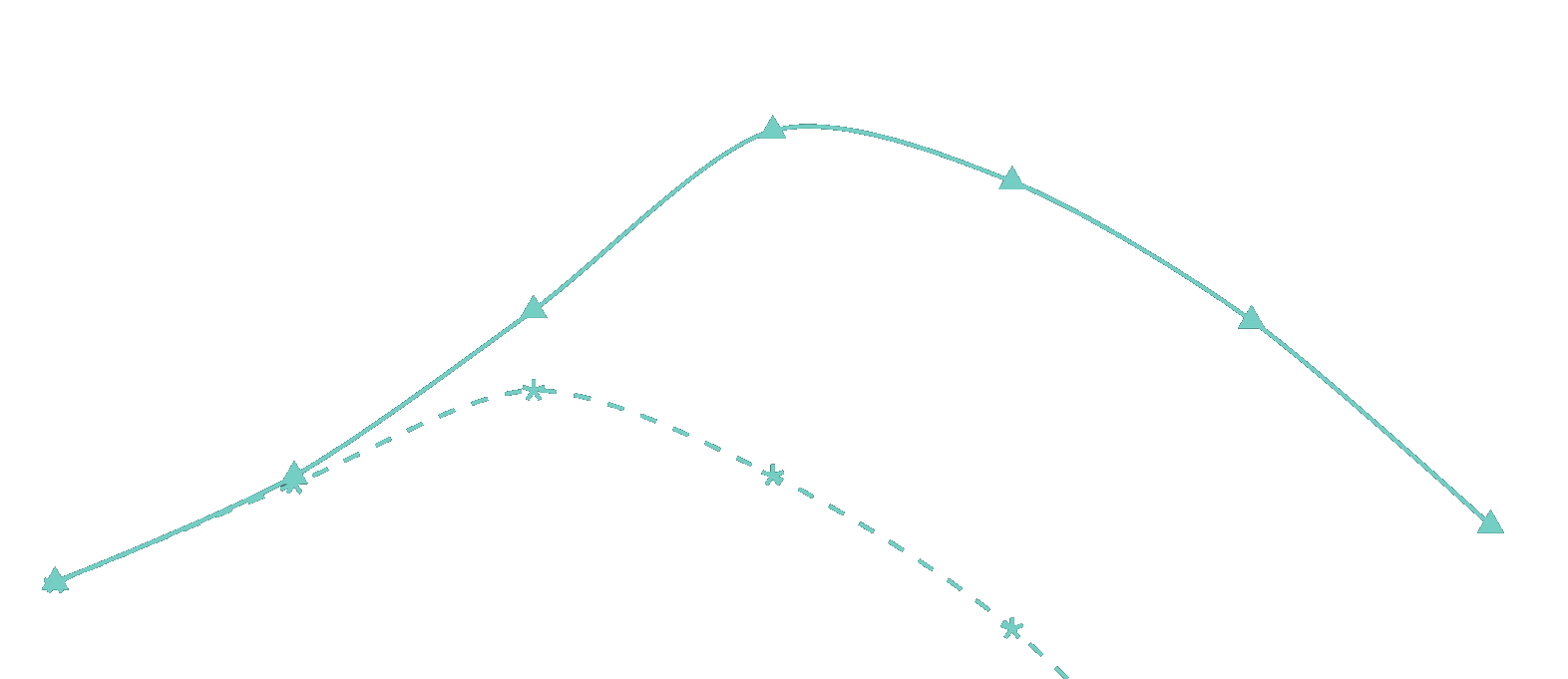
Results

d=2
d=3

                 Toom-cook

                 Schoolbook

Switchover round \(t\)

Factor improvement  \((t_{\textsf{naive}} / t_{\textsf{algo}})\) for \(n=20\)

Product Sumcheck

p(x) := p_1(x) \cdot p_2(x) \cdots p_d(x)
  • We need sumcheck to prove (multilinear) polynomial relations like
  • Sumcheck round polynomial in round \(i\)
s_i(c) := \sum_{x \in \{0, 1\}^{\ell - i}} p(r_1, r_2, \dots, r_{i - 1}, c, x)
= \sum_{x \in \{0, 1\}^{\ell - i}} \prod_{j=1}^{d} p_j(r_1, r_2, \dots, r_{i - 1}, c, x)

Product of extension-field elements

Product Sumcheck

s_i(c) := \sum_{x \in \{0, 1\}^{\ell - i}} p(r_1, r_2, \dots, r_{i - 1}, c, x)
= \sum_{x \in \{0, 1\}^{\ell - i}} \prod_{j=1}^{d} p_j(r_1, r_2, \dots, r_{i - 1}, c, x)

Product of extension-field elements

Product Sumcheck

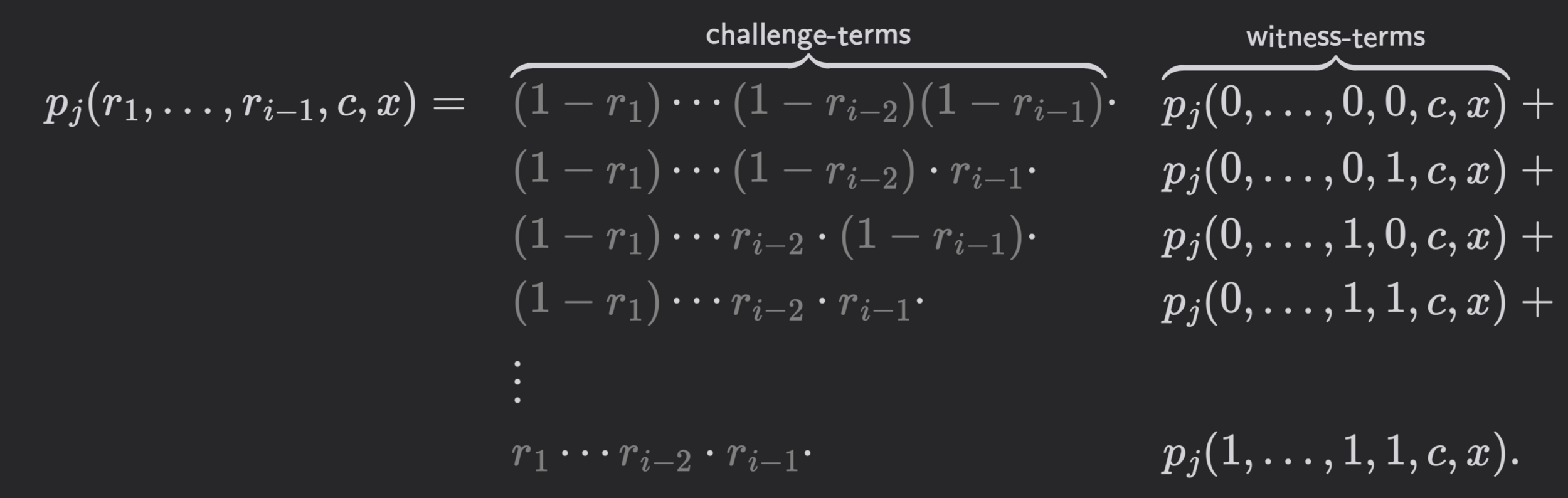
p(r_1, c, x) = \textcolor{grey}{(1-r_1)} \cdot \textcolor{red}{p(0, c, x)} \quad + \quad \textcolor{grey}{r_1} \cdot \textcolor{lightgreen}{p(1, c, x)}
q(r_1, c, x) = \textcolor{grey}{(1-r_1)} \cdot \textcolor{red}{q(0, c, x)} \quad + \quad \textcolor{grey}{r_1} \cdot \textcolor{lightgreen}{q(1, c, x)}
\implies p(r_1, c, x) \cdot q(r_1, c, x) =
\begin{aligned} &\textcolor{grey}{(1-r_1)(1-r_1)} \cdot& & \textcolor{red}{p(0, c, x) \ q(0, c, x)} \ + \\ &\textcolor{grey}{(1-r_1)r_1} \cdot & & \textcolor{red}{p(0, c, x)}\ \textcolor{lightgreen}{q(1, c, x)} \ + \\ &\textcolor{grey}{r_1(1-r_1)} \cdot & & \textcolor{lightgreen}{p(1, c, x)}\ \textcolor{red}{q(0, c, x)} \ + \\ &\textcolor{grey}{r_1r_1} \cdot & & \textcolor{lightgreen}{p(1, c, x)\ q(1, c, x)} \end{aligned}

Product of Linear Polynomials

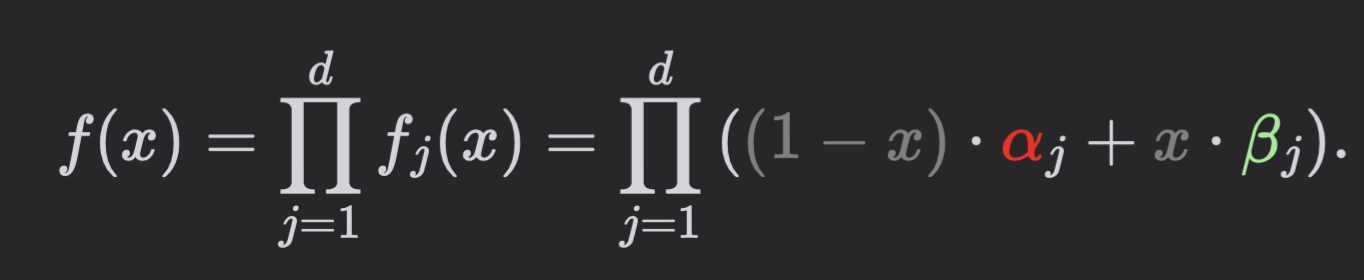
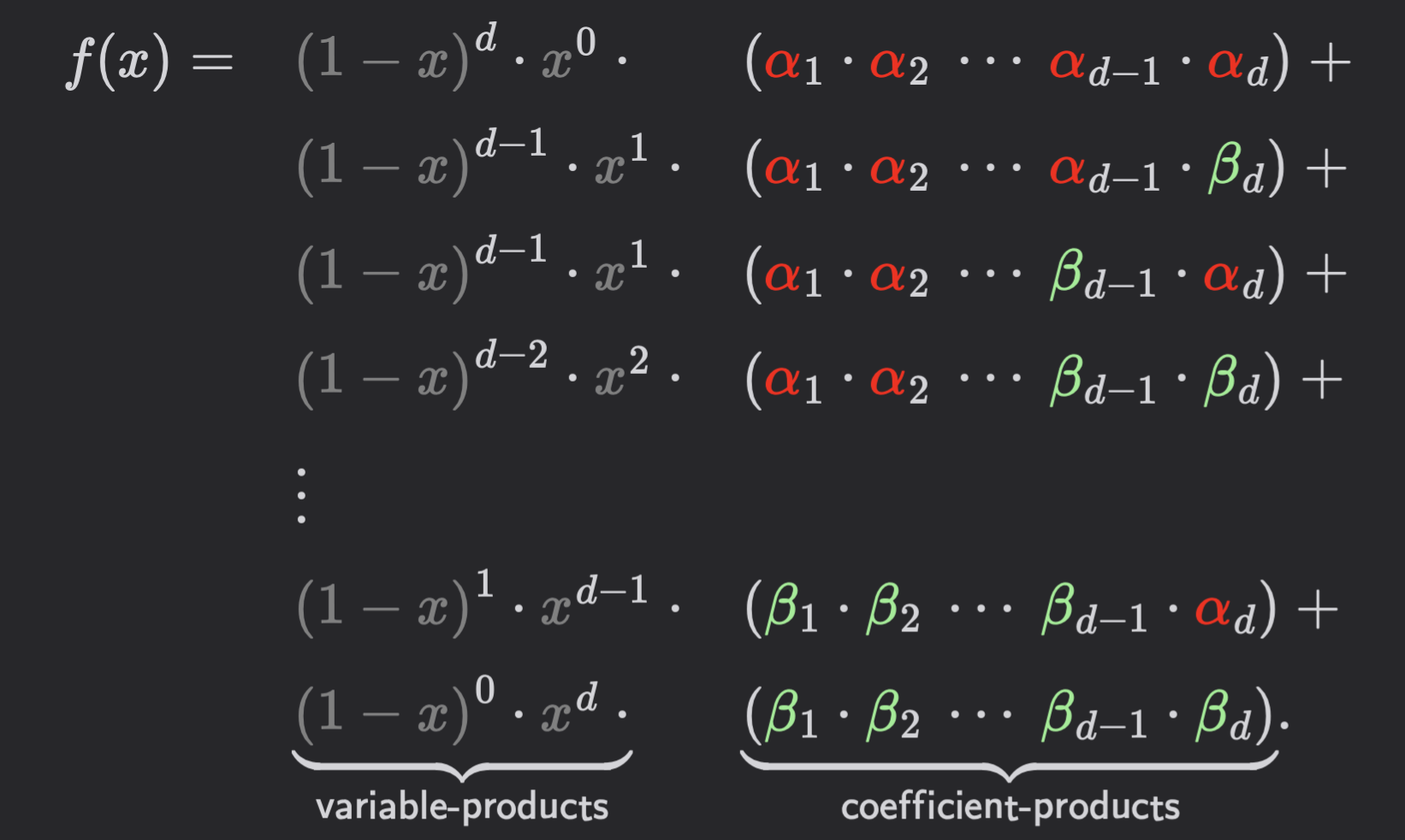
  • Let \(f_1, f_2, \dots, f_d\) be linear polynomials s.t.
  • Using school-book multiplication
\implies (d - 1) \cdot 2^d \ \textsf{bb}

Efficient Product of Linear Polynomials

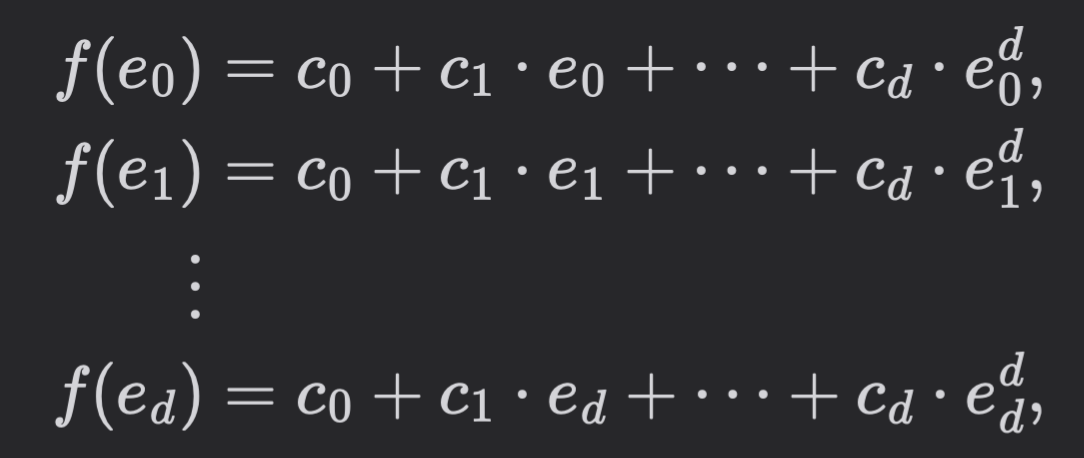
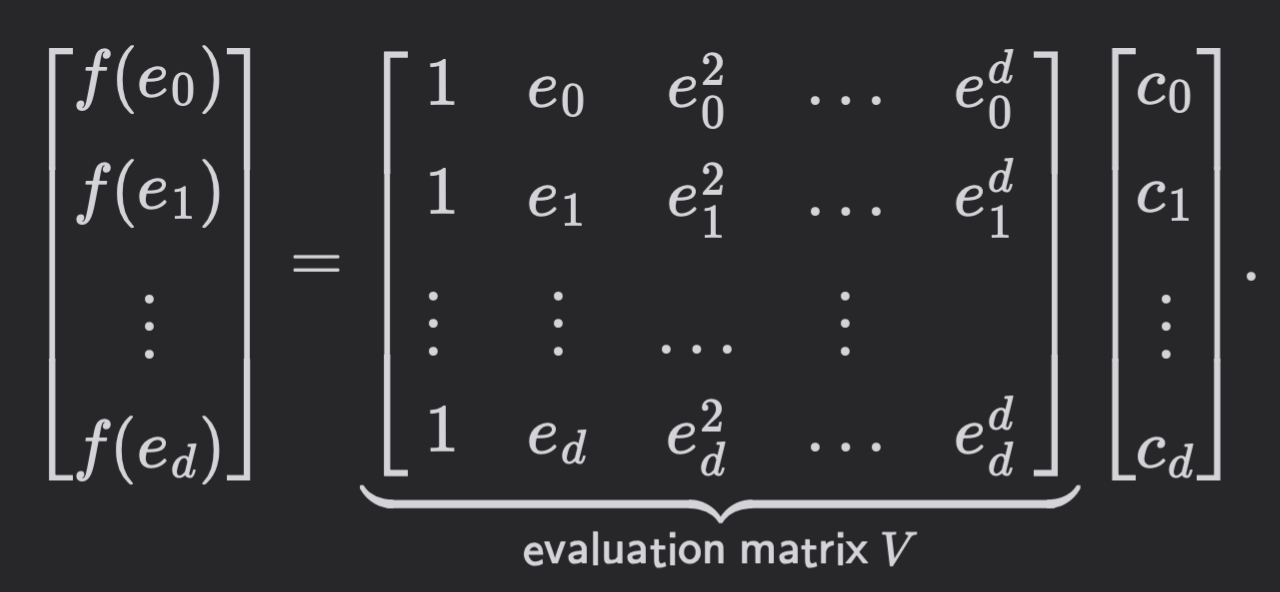
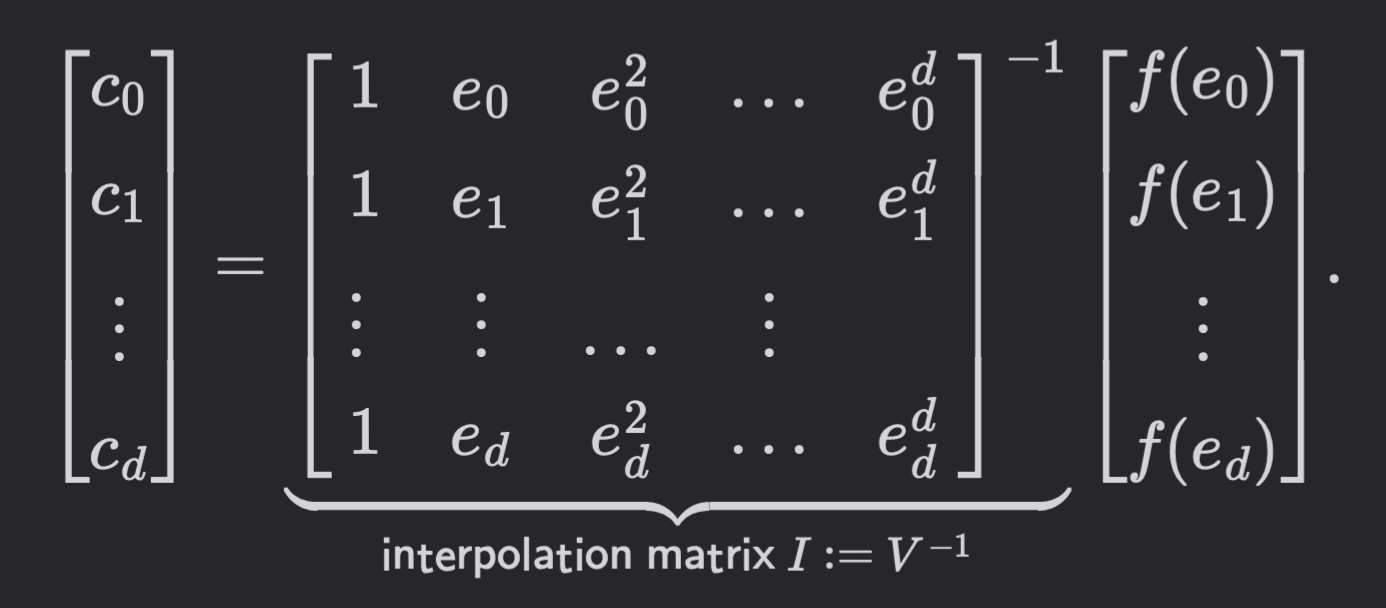
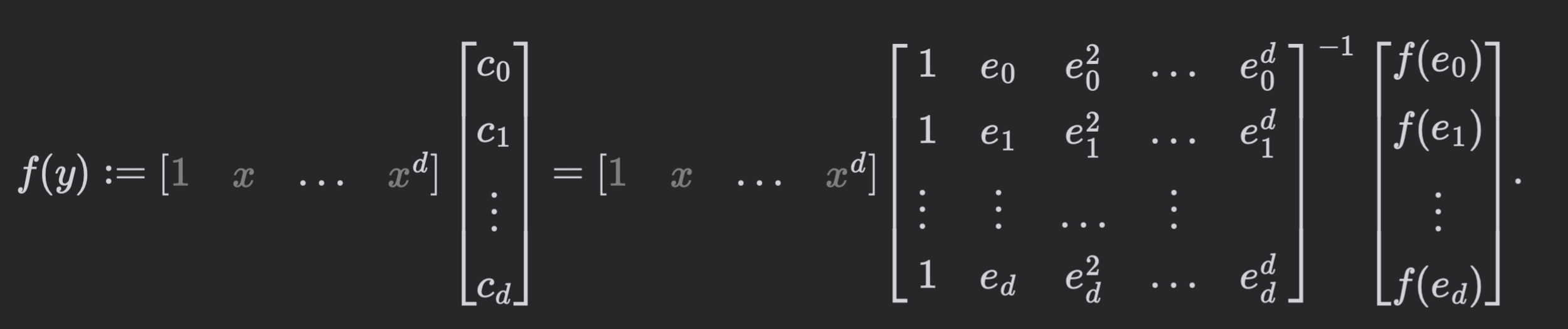
  • Degree of \(f\) is \(d\). To compute \(f(x)\):
    • Evaluate each \(f_j\) on \(d + 1\) points \(\{e_0, e_1, \dots, e_d\}\)
    • Compute point-wise multiplication on all \(d\) points to get \([f(e_0), \dots, f(e_d)]\)
\implies
\implies
\implies (d - 1) \cdot (d + 1) \ \textsf{bb}

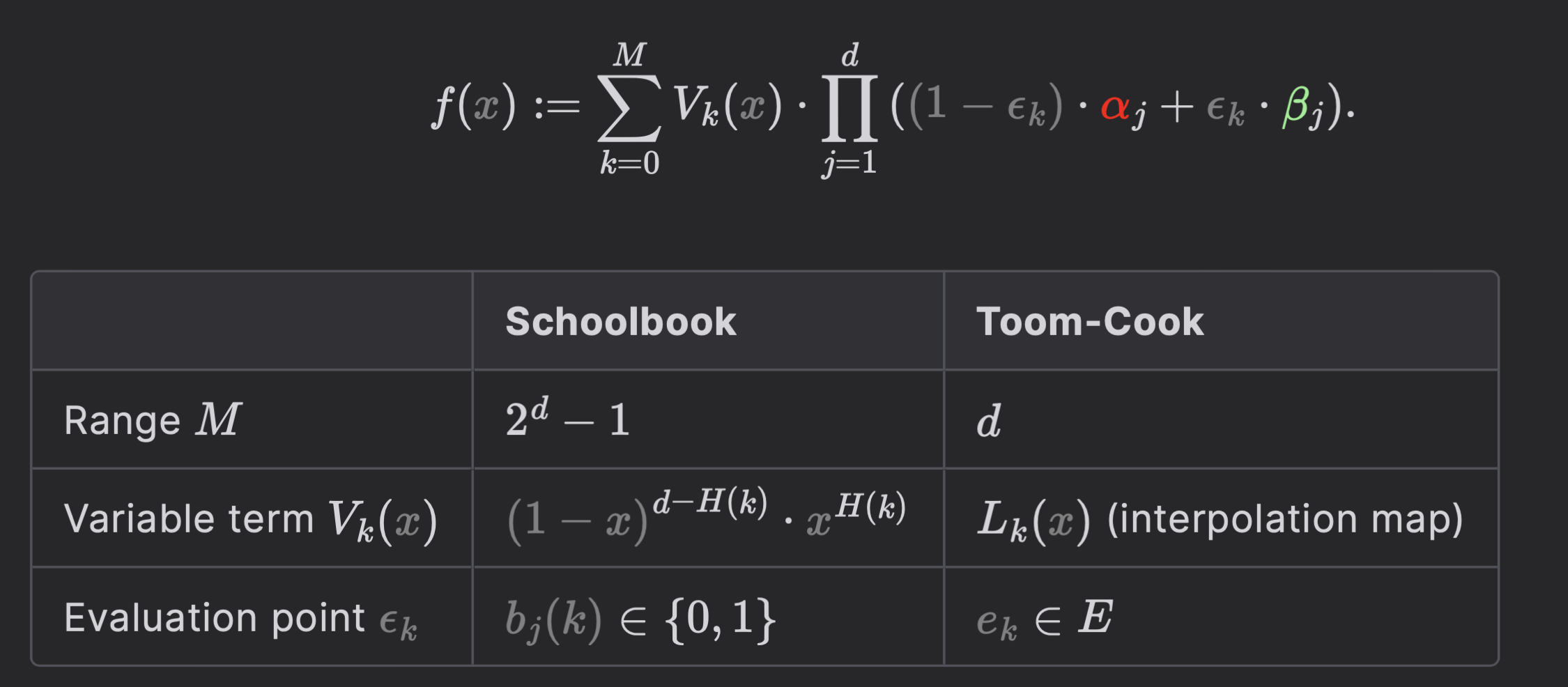
Schoolbook method

Toom-Cook method

\implies (d - 1) \cdot (d + 1) \ \textsf{bb}
\implies (d - 1) \cdot 2^d \ \textsf{bb}

Efficient Product of Linear Polynomials

Schoolbook method

Toom-Cook method

Efficient Product of Linear Polynomials

Back to Sumcheck

\implies
\implies
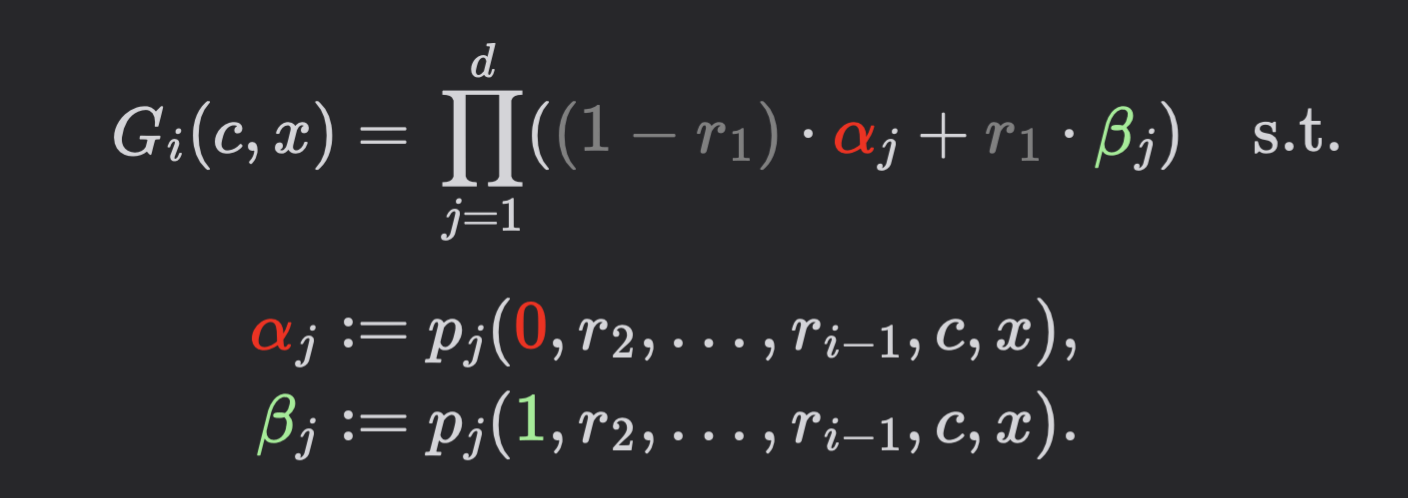
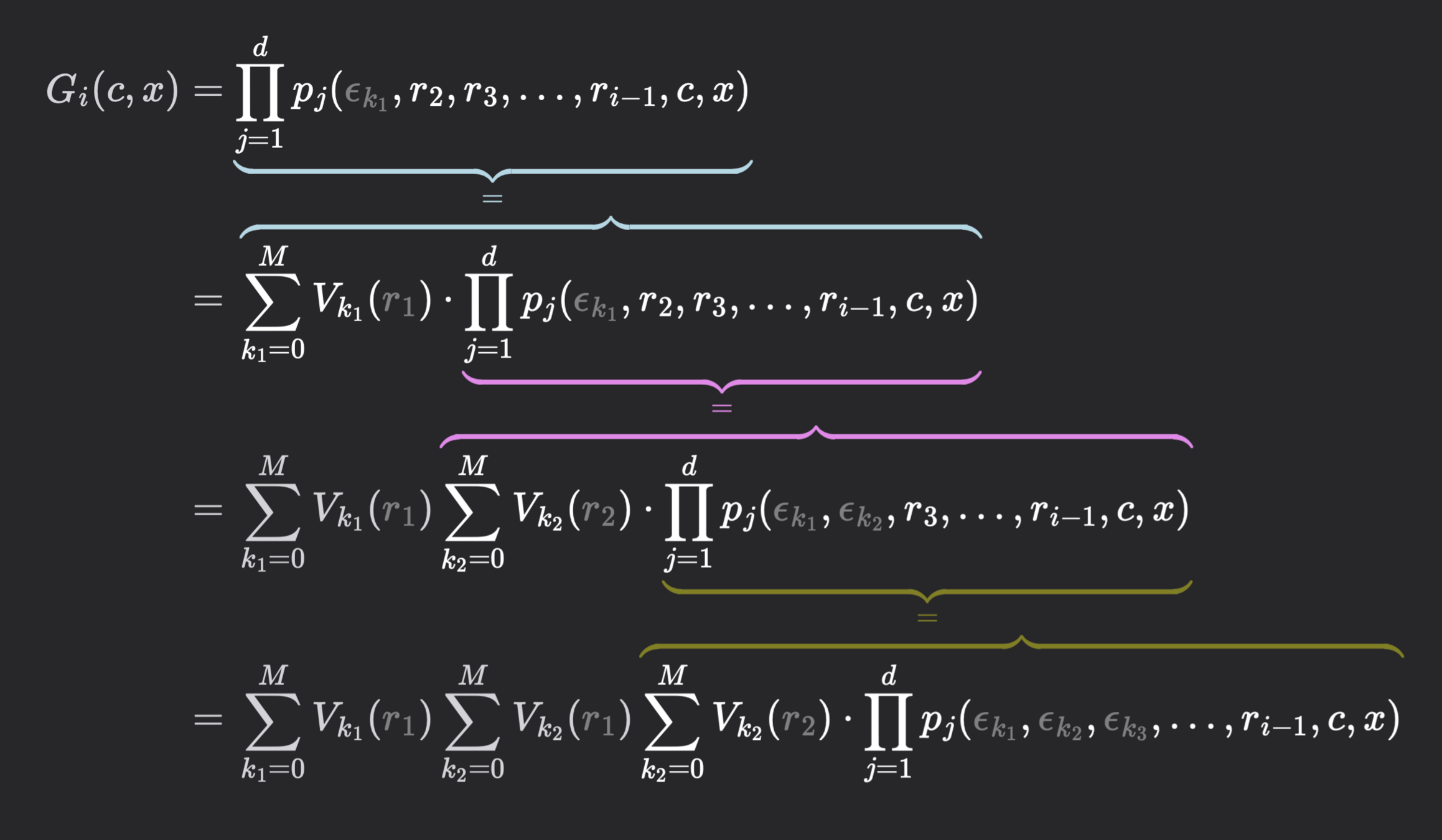
s_i(c) = \sum_{x \in \{0, 1\}^{\ell - i}} \prod_{j=1}^{d} p_j(r_1, r_2, \dots, r_{i - 1}, c, x)
  • Round polynomial expression:

Let us call this \(G_i(c, x)\)

Back to Sumcheck

Why Toom-cook?

d=2
d=3

                 Toom-cook

                 Schoolbook

Switchover round \(t\)

Factor improvement  \((t_{\textsf{naive}} / t_{\textsf{algo}})\) for \(n=20\)

0.6 \text{ MB}
84 \text{ MB}

10x Faster Sumcheck over Binary Tower Fields

By Suyash Bagad

10x Faster Sumcheck over Binary Tower Fields

  • 132